Strategy isn't the problem: why leadership teams actually get stuck
You've restructured the team twice. You've added a new layer of process, hired a consultant, and even ran an offsite. Yet the same problems keep surfacing: decisions made without buy-in, messaging that shifts every quarter, people stuck without clear ownership. The org chart looks clean on paper. So why does it feel broken?
The answer—backed by research from eight HR leaders and founders across companies of all sizes—is counterintuitive: it's not the strategy that's broken. It's how people work together.
The 3 patterns that block leadership teams (regardless of size)

In July 2026, we asked HR leaders and founders what keeps coming up in their organisations—not one-off issues, but the patterns that recur month after month. The responses, spanning teams of 1–5 people to organisations with 750+ employees, revealed three remarkably consistent themes.
“Too many cooks, too much process, no one protecting the team”
Organisations that grew fast in good times built complex infrastructure to support scale. Now that environment has shifted, but the complexity remains. Leaders describe the same friction: decisions get made by committee, messaging becomes inconsistent as it travels down the chain, and senior leaders spend their energy shielding their teams from corporate noise instead of doing the work itself.
One HR Lead in a 750+ person organisation put it bluntly: "In the end, too many cooks in the kitchen. The organisations grew too big and too complex in good times. Now the over-engineering is preventing many meaningful changes."
The pattern isn't unique to large companies. Founders in 1–5 person teams report the same dynamic on a smaller scale: everyone has input, no one has clarity, and the founder ends up managing sideways instead of leading forward.
“Interpersonal skills, not strategy, are the actual bottleneck”
Here's where the research gets sharp. Multiple respondents independently identified the same root cause, often without prompting: people over-focus on frameworks, processes, and strategic plans when the real friction is interpersonal.
They named it exactly: people don't know how to self-regulate under pressure, communicate honestly across disagreement, or stay out of survival mode. One respondent described it: "People hyperfocus on the strategy and the plan when really, most of the issues causing friction and inefficiency are interpersonal. People not knowing how to self-regulate, communicate, and living in survival."
This is worth sitting with. Most leadership teams, when they feel stuck, reach for the thing that feels concrete: add a process, clarify the org chart, bring in someone new. What they rarely do first is address whether people in the room know how to talk to each other when stakes are high.
“Ego and unclear ownership fracture leadership teams from inside”
In larger organisations, the pattern shows up as ego—differing agendas among leaders that cascade as mixed messaging to the business, blurred boundaries of responsibility, and a felt distance between "the inner circle" and the rest. One HR Lead described it: "Poor collaboration within the leadership team, differing agendas. This is then reflected in mixed or inconsistent messaging to the business."
In smaller, founder-led teams, it shows up as ownership that's never quite settled. Who's really accountable? It's unclear, and that ambiguity ripples through every decision.
What leaders have actually tried (…and why most of it doesn't work)
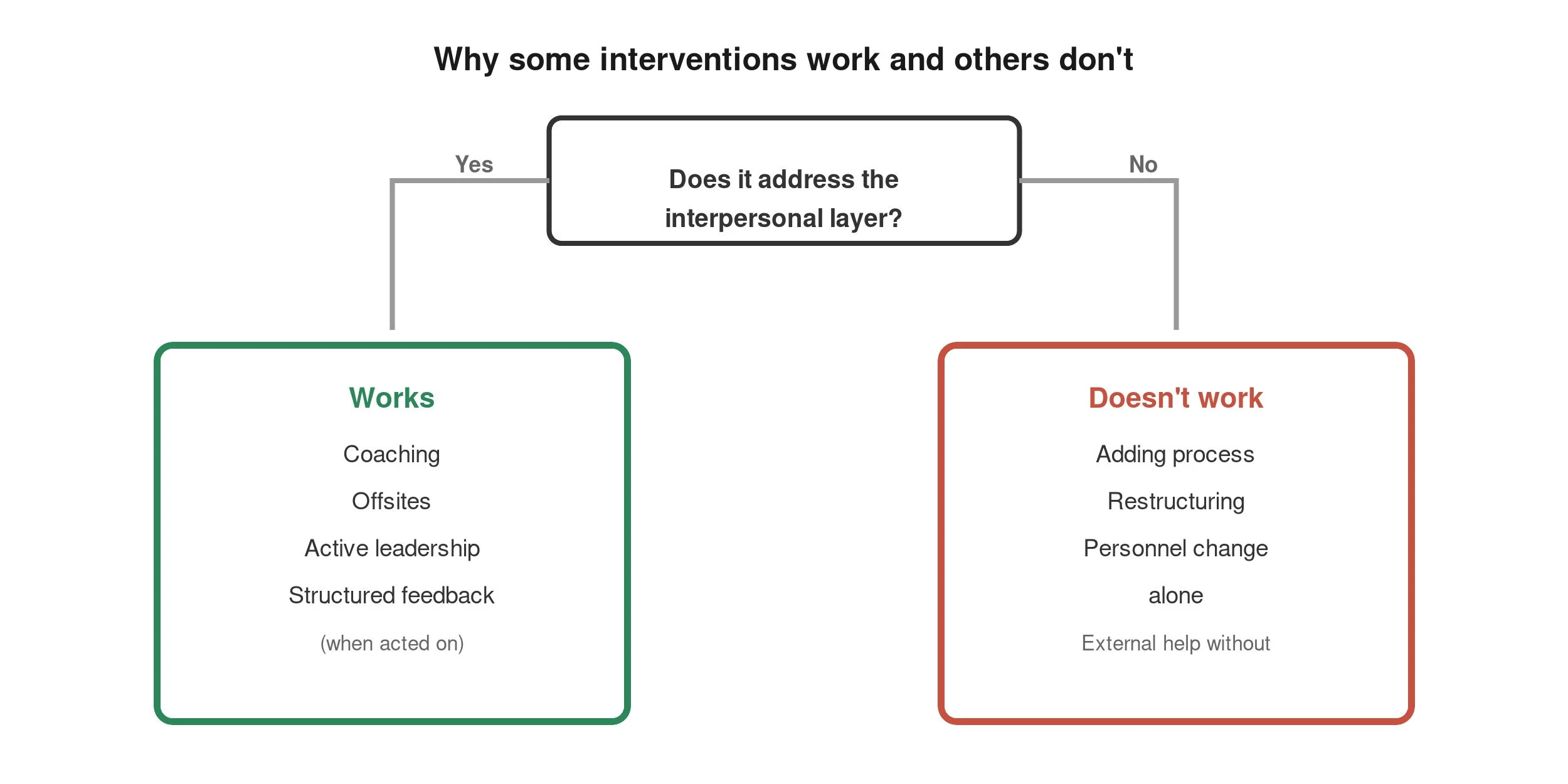
Every single respondent had already tried something. The list reads like a playbook of conventional fixes: restructuring, adding process, coaching or training, personnel change, team building events, offsites, and external consultants.
The data reveals something important: most of these interventions fail when applied in isolation.
Restructuring alone doesn't solve problems rooted in how people communicate. Adding process on top of dysfunction amplifies frustration. Bringing in a consultant without follow-through leaves the team worse off—they've spent time and money, and nothing has shifted. One frustrated HR Lead noted: "I tried six different things. Nothing worked. It's still an issue."
But here's what stands out: the interventions that do work share a common thread—they address the interpersonal layer directly.
What actually works: The common thread

Coaching and offsites emerge as the two interventions leaders consistently report as effective. Why? Because they work on the terrain where the actual problem lives: how people in the room relate to each other, communicate under pressure, and rebuild trust across roles.
Effective coaching addresses the individual—helping leaders regulate their own state, communicate more clearly, and model the behaviour they want to see. Offsites address the collective—giving a leadership team structured time to communicate honestly, surface disagreements, and align on what matters.
The distinction matters: these interventions work because they're interpersonal, not despite it. They don't bypass the hard work of trust-building; they enable it.
Active leadership modelling also emerged as effective—when founders or senior leaders visibly change how they work, others follow. Structured feedback loops work when they're genuinely acted on, not just collected.
What doesn't work: adding more process, restructuring without addressing the interpersonal layer, and bringing in external help without sustained follow-through.
The urgency is real
Three-quarters of respondents ranked this pattern as a priority 4 or 5 (on a scale of 1–5). The majority describe it as constant, ongoing—not something that flares up occasionally, but a daily friction that bleeds energy and slows progress.
For founders and HR leads, this isn't abstract. It's the reason decisions take longer than they should. It's why the right people leave. It's why strategy that looks good on a slide doesn't translate into action.
What this means for how you lead
The research points to a simple reframe: stop treating interpersonal challenges as soft or secondary. They're not. They're the difference between a leadership team that functions and one that's stuck in recurring conflict.
If your team is stuck—if decisions move slowly, messaging is inconsistent, or people seem to be operating with different agendas—the first place to look isn't the org chart. It's the room itself. Can people in the room communicate honestly? Do they trust each other enough to disagree? Do they know how to regulate when things get heated?
Those questions have nothing to do with strategy and everything to do with whether strategy actually gets executed.
The leaders doing this work best aren't waiting for the perfect process or the right hire. They're investing in the one thing that multiplies the effectiveness of everything else: how their teams actually work together. That's where real transformation happens.